

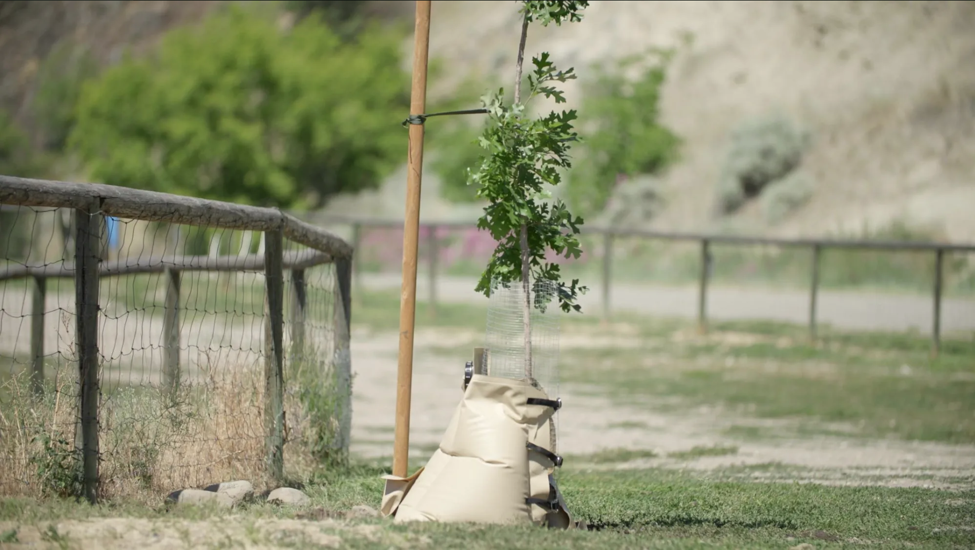
For Passive Earth founder Sam Beatch, Web Summit Vancouver arrived at a critical moment. His B.C.-founded company had developed a climate-resilient tree bag and drop-in irrigation system designed to help newly planted trees survive periods of extreme heat and drought. This innovation was spurred through real-world observation: In 2024, the City of Vancouver asked residents to adopt a street tree and water it through the summer. Nearly half of the city's newly planted trees were dying before they established. Sam read the notice and saw the problem and solution: "When a crew fills a conventional watering bag it becomes empty within hours, so the tree gets one day of water and then waits a week for the truck to return. We built a tree bag with subsurface irrigation that keeps watering for nine days, installed with the tree at planting, so the water arrives across the whole gap," he notes.
His solution quickly generated interest from cities seeking more resilient urban forestry solutions but, like many early-stage hardware startups, actually getting the product to the public before time, money, and opportunity ran out was a real challenge. “There’s a delicate dance you have to do as an early-stage company and inventor,” Beatch says. “A patent is nearly mandatory for a hardware business — investors expect one, and you need one to sell into other markets — yet the cost of a full filing sits far beyond what bootstrap funding can cover.”
The pressure was practical as much as financial. After filing a provisional patent, Beatch had 12 months to prove the business had a path forward. A municipal pilot had to be secured in time to plant, the trees had to be planted in time to water, and the results had to be strong enough to support the next stage of growth. In the narrow window between invention and adoption, everything had to line up.
For more than a year, Passive Earth had been trying to move municipal conversations from interest to implementation. The support was there, but the timing was difficult. “The interest was always there; converting it into trees in the ground was the slow part,” Beatch recalls.
A Second Chance Through Road to Web Summit Vancouver
Passive Earth was not initially accepted into Web Summit Vancouver as a Venture Spotlight company. At the time, the company did not yet have a website, and Beatch was still refining the materials needed to tell the company’s story clearly. But Innovate BC saw promise in the pitch and invited him to participate in the Road to Web Summit Vancouver Venture Scaling Master Class.
The intensive program helped him strengthen his business presentation, sharpen his pitch, and better understand how investors evaluate early-stage companies. “That course taught me how investors actually evaluate a business and how to think about long-term planning,” he says. “It accelerated a lot for me.”
A few weeks later, after improving his materials, Beatch applied again and, this time, Passive Earth was accepted into Innovate BC’s Venture Spotlight at the BC Pavilion.
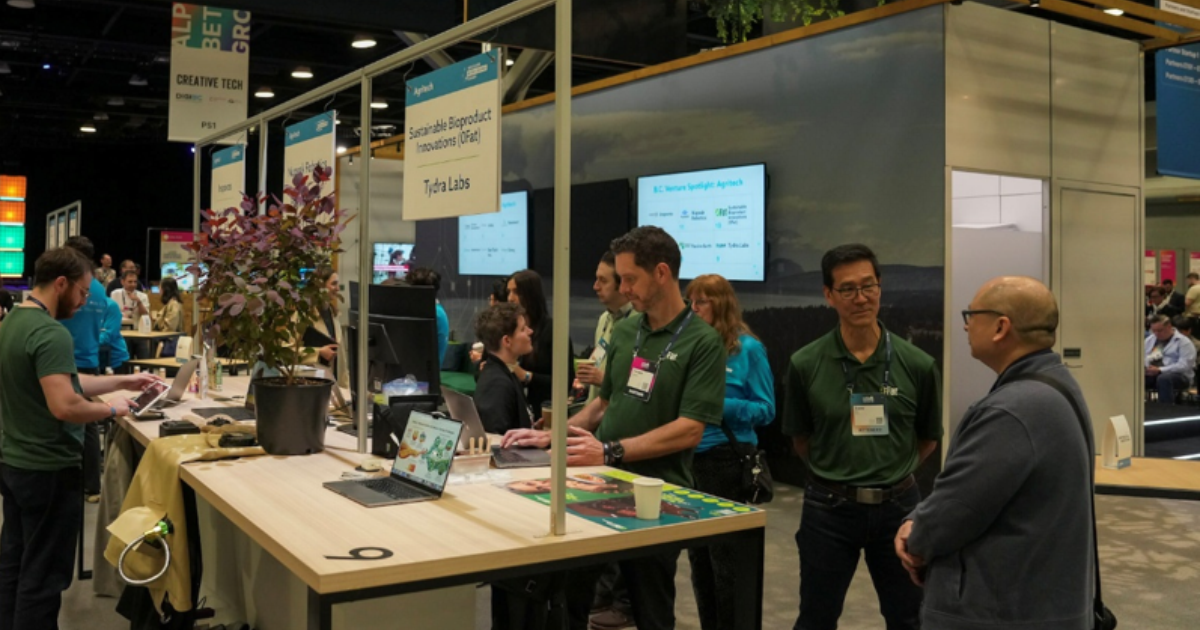
The Right Conversations in the Right Room
At Web Summit Vancouver, the digital barriers that had slowed Passive Earth’s progress began to disappear. Instead of waiting on email replies, Beatch was speaking directly with city councillors, government officials, ecosystem leaders, investors, and climate innovation peers — the kind of concentrated access that can compress months of outreach into a few consequential conversations.
“The best thing about Web Summit is the range of people in the room,” he says. “After a year of working leads the slow way, the right conversations in the right room did it in hours.”
One of those conversations centred on the Okanagan, where drought and heatwaves are an increasing concern for urban trees. Beatch shared the need for Passive Earth’s solution with a federal official at ISED and later made the same case to the CEO of Foresight Canada. From there, the idea travelled quickly.
“Someone I spoke with carried it to a city councillor — and two hours into my day at the booth, a pilot inquiry from the City of Kelowna landed in my inbox,” Beatch says. “No one there had heard of me or seen my website before. The idea travelled purely by word of mouth, from a conversation at my booth to a councillor to an email, in a single morning.”
The timing changed more than one opportunity. It changed how Beatch could speak about the business for the rest of the conference. “And I got that email while I was standing at my booth as a Venture Spotlight company for Innovate BC. For the rest of the conference, every conversation — councillors, government officials, investors, passersby at the booth — could now include that we were piloting with the City of Kelowna. That changed the conversation completely. I wasn’t pitching an idea anymore. I was pitching traction.”
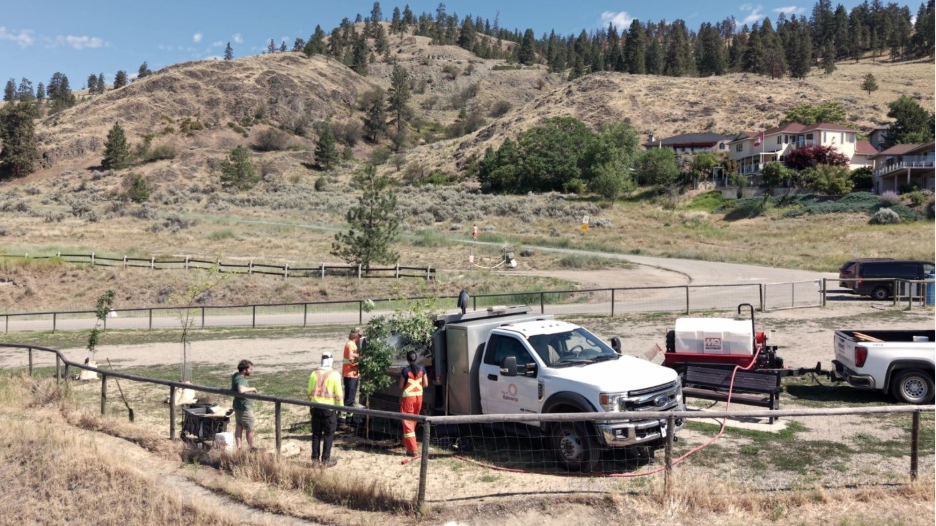 Passive Earth and the City of Kelowna install the tree bags on a hillside above Okanagan Lake.
The Pilot Project Delivers: Proof, Validation, and Valuable Product Stress Testing
Within three weeks, Passive Earth's tree bag and subsurface irrigation system was in the ground in Kelowna. The City Arborist said it was the last day of the season he would plant any trees: it was so hot that even the irrigated trees were struggling.
The pilot became the ultimate stress test for the mechanism. The weather station logged 49 days without measurable rain, and by the arborist's own count it was 64 days without proper rainfall. Every litre those trees received arrived by the City's water truck, and the Tree Guardian trees held through 38°C.
“The pilot gave me the proof I’d been chasing for a year: real trees on a real site, with feedback from Kelowna's Urban Forestry program," Beatch says. It also led to the sale of the first units, weekly field results the company now publishes, and a verdict from the city at the end of the season. Additionally, Beatch now has the product feedback he needed to commit to a first commercial run of 1,000 units, he has also gained grant funding and support from Futurpreneur.
The results unlocked the company's intellectual property strategy, as well, with support through AccelerateIP with New Ventures BC and the Innovation Asset Collective. "The patent I'd spent a year afraid of losing is now getting funded before the clock runs out. That was the entire goal of the year," Beatch says. "I walked into Web Summit a solo founder sweating a deadline. The planting season was nearly over. I walked out with the trajectory of my year transformed." 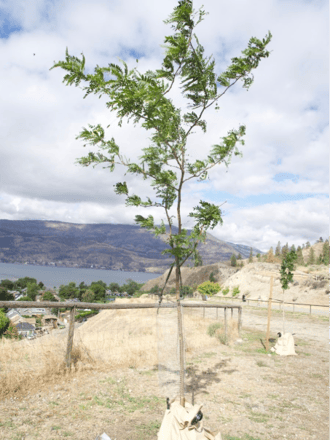
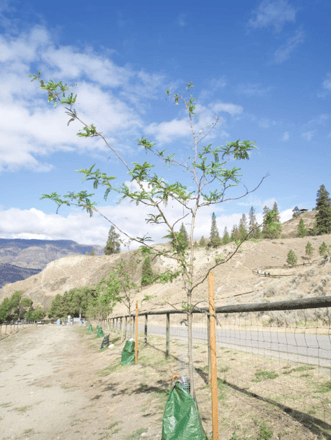
Left: A honey locust tree in a Tree Guardian bag. Right: A honey locust tree in a standard watering bag.
Other Doors Opened by Web Summit Vancouver: Community, Confidence, and Momentum
Beyond the immediate pilot and product sales, Web Summit Vancouver also gave Passive Earth access to a community of founders, sector leaders, and climate innovation partners. For Beatch, being situated near Agritech programming and other BC Pavilion companies made it easier to find relevant conversations and build relationships with people who understood the market.
“I especially liked how the panel talks pulled in different sectors,” he says. “It made it easy to strategically find the industry contacts that actually mattered to me, instead of guessing who to approach.”
The experience also shifted Beatch’s confidence in the future of the company. A year earlier, Passive Earth had no commercial validation, no website, and only his own testing to point to. Now, the company has a successful municipal pilot, a funded patent strategy, and an investor raise on the horizon.
"Thirty to forty percent of newly planted trees dying in North America is the number we're going after," Beatch says. Focused on saving municipalities money, crew visits, water, and tree replacements, he adds that "We are going to save trees, cool our cities, conserve water, and be a Canadian climate solution the world buys."
Founder Advice: Get in the Room
Asked what he would tell another startup founder considering a future Web Summit Vancouver or Innovate BC program, Beatch’s advice is simple: show up, talk to people, and build relationships.
“Go, and talk to people,” he says. “You never know who you’re talking to, who they know, or what opportunities a single conversation can lead to. That’s literally how Kelowna happened.”
For Passive Earth, one week of preparation on a year of groundwork, one booth in the BC Pavilion, and a series of conversations helped turn a promising idea into a real-world pilot, product sales, new funding pathways, and renewed momentum. Feedback from the City of Kelowna noted that Passive Earth's solution is a better method of watering, and they plan to plant more trees from fall into 2027. Four pilots across BC and Alberta are also planned for 2027, alongside an instrumented study at Hampton Place, UBC, through the University Neighbourhoods Association. Plus, the company is deep in talks on a three-year, large-scale tree survival study with an Alberta municipality and a university partner.
Their success also shows why access matters: when innovators are connected to the right networks, practical solutions are far more likely to reach the communities that need them most.
Learn more about Passive Earth’s Tree Guardian solutions and pilot programs.
Ready to connect with B.C.’s innovation ecosystem and make the most of Web Summit Vancouver in 2027? Explore the latest opportunities, programs, and ways to get involved:
- Become an Innovate BC Insider
- Register for Web Summit Vancouver 2027
- Learn more about the BC Venture Spotlight
- Explore B.C. opportunities
- Read our Web Summit Vancouver 2026 recap blog
Share
Web Summit Vancouver 2026: A Landmark Opportunity for B.C.’s Innovation Ecosystem

FutureTwin AI: Empowering the Next Generation with Smarter Guidance